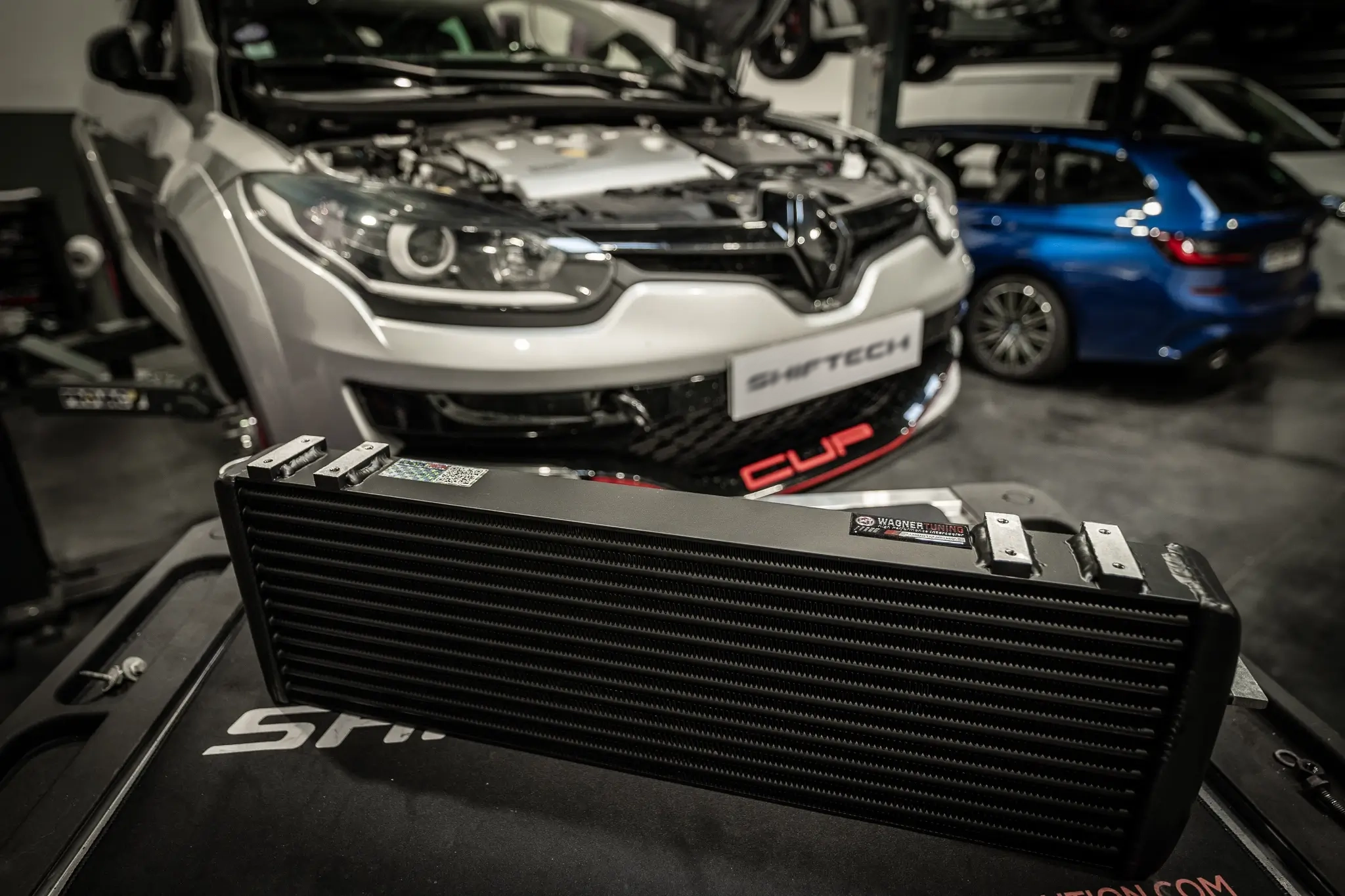
All you need to know about heat exchangers!
What is an intercooler or air exchanger?
The intercooler, also known as the air exchanger, plays a crucial role in the efficiency and performance of compressed engines. Its main purpose is to cool the air compressed by the turbo or compressor before it enters the engine block.
When the turbo (or compressor) compresses the air coming from the filter, it increases the engine's power and torque, but this process also generates heat. This excessive heat reduces the density of the air in the intake, which can reduce the engine's overall efficiency.
This is where the intercooler comes in: by cooling this compressed air, it minimises the negative effects of heat while optimising the density of the air injected into the engine. As a result, combustion is more efficient, offering improved engine performance.
There are two main types of intercooler: air-to-air and air-to-water. In the first case, the compressed air is cooled by outside air, while in the second, water is used as the cooling agent. Each system has its own specific advantages and applications, depending on the engine's needs.
Why optimise my air exchanger?
By installing a large intercooler, you can get round this heating phenomenon. Thanks to a large-volume intercooler, the compressed air is cooled better, making the air entering the engine denser (the cold air occupying less volume). This allows a greater quantity of air to be injected into the engine, leading to optimum combustion and an increase in torque and engine power.
Thanks to this optimisation, the temperature in the intake circuit is better controlled. Performance can then be increased without fear of intake overheating, which could reduce ignition advance. In the most critical situations, this can lead to knocking.
Another significant benefit is the ability to maintain constant acceleration without degrading power during intensive use or on the racetrack, and to ensure stable power even during temperature peaks.
How can I optimise my air exchanger?
Plug & Play large-volume intercooler
The installation of a Plug & Play large-volume intercooler is chosen according to make and model. It does not require any major modifications to the original system, and is fitted in place of the original intercooler. For major performance optimisation, it should be combined with a stage 2 reprogramming.
Intercooler kits or universal intercoolers
A universal intercooler can be adapted to different engines, unlike a Plug & Play intercooler dedicated to a specific model or engine. There are advantages and disadvantages to choosing this type of intercooler.
The size and design of the intercooler can deliver better performance than the original.
However, installing this type of exchanger kit usually requires custom modifications, unlike a Plug & Play intercooler. It's not uncommon for the intake system to have to be modified. What's more, it's essential to adjust the engine mapping to stage 2 reprogramming. Although this promises significant increases in performance, it can be relatively complex to carry out.
it should be noted that there are different types of mounting, depending on the location of the intercooler:
- FMIC (Front Mounted Intercooler): the intercooler is positioned frontally in the centre of the front of the vehicle.
- SMIC (Side Mounted Intercooler): the intercooler is positioned on one side of the front of the vehicle.
- TMIC (Top Mounted Intercooler): the intercooler is located in the engine compartment of the vehicle, on top of the engine.
What brand of intercooler should I choose?
Many well-known brands offer quality intercooler kits, including Wagner Tuning, Airtec, TA-Technix, Dbilas Dynamic, Forge Motorsport, Mishimoto, HKS and others.
Each of these brands offers high-flow intercoolers for a wide range of vehicles, from BMW and Audi to Volkswagen, Seat, Mercedes, Renault, Porsche, Peugeot and many others.
The technicians at our centres will be able to advise you, depending on the make and model of your vehicle, on the exchanger best suited to your needs, so don't hesitate to contact us.