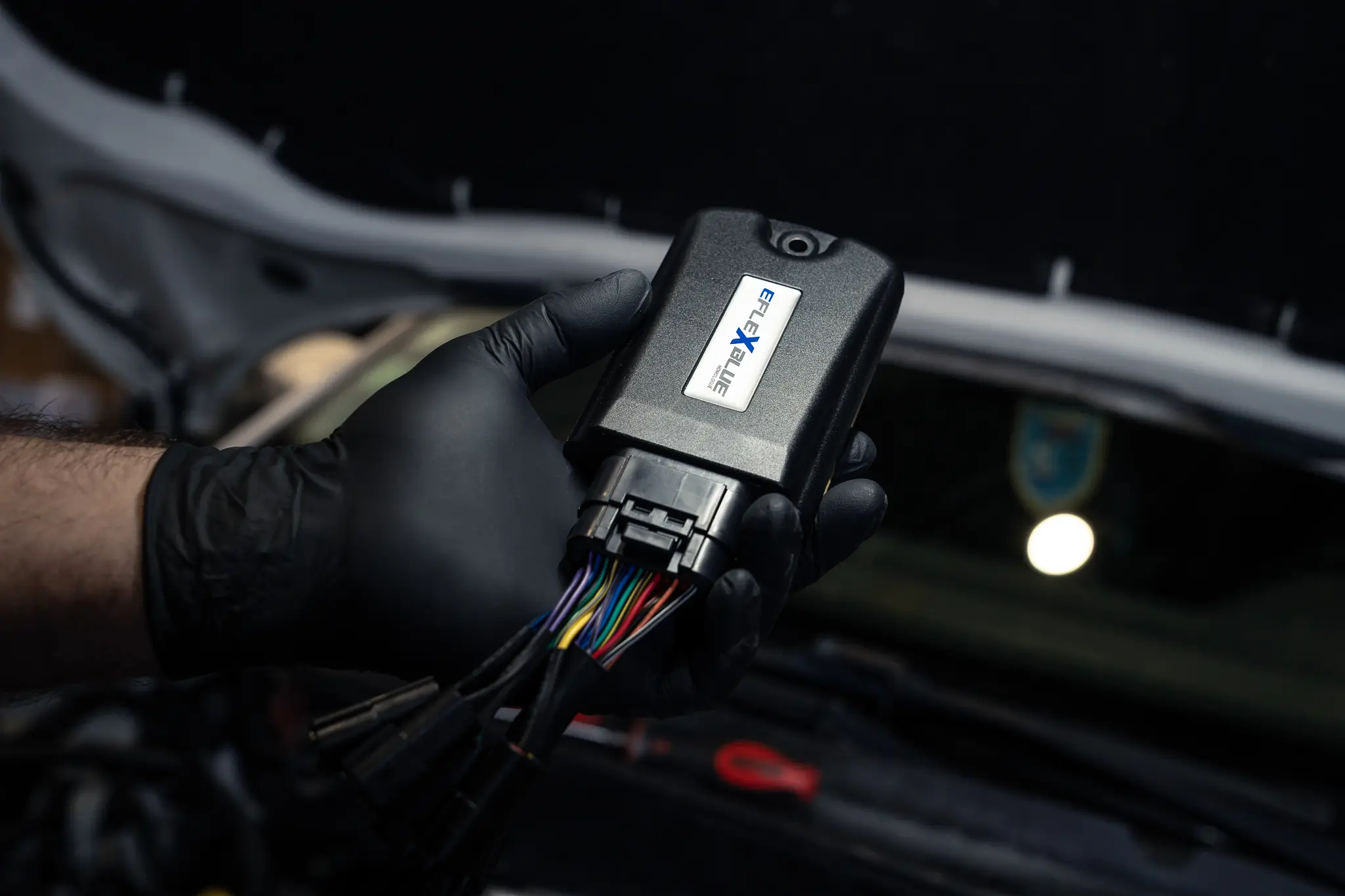
Fitting an ethanol kit: a step-by-step guide to the installation process
In summary: the fitting of an approved ethanol conversion kit is carried out in a workshop by an installer authorised by the kit manufacturer, such as Shiftech. The technician checks the engine, connects the kit to the injectors without tampering with the ECU, calibrates it and then tests the car.
At Shiftech, the fitting takes an average of 1 to 2 hours, though it may take longer for a direct-injection engine. You’ll leave with the documents you need to have your vehicle registration certificate updated to allow for E85 use.
Who is allowed to fit an approved ethanol conversion kit?
Only an installer authorised by the device manufacturer may fit it. This is stipulated in the Order of 30 November 2017: only devices that have been type-approved and fitted by an authorised installer may be fitted to a car used on public roads.
Before granting this authorisation, which is valid for a maximum of three years, the manufacturer trains the fitter on its unit and the installation requirements. It then monitors the fitter’s work through regular inspections.
Shiftech is an authorised installer for both manufacturers whose units we fit: FlexFuel Energy Development, a French manufacturer, and eFlexFuel, for whom we fit the version approved in France, the eFlexBlue. As specialists in engine remapping, our technicians select the control unit based on the Euro standard, the type of fuel injection system and your car’s tax power rating.
What to check before fitting a housing
It all starts with your vehicle registration document. The Euro standard (box V.9), the tax power rating (box P.6) and the type of fuel injection system determine your car’s type-approval category, and therefore which control unit can be fitted. At our Shiftech centres, you enter your registration number on the request form: your centre checks for compatibility and sends you a quote before booking your appointment.
If your engine does not fall into any approved category, or if you’re also looking to boost power, our technicians will suggest an alternative option: ethanol remapping, which modifies the ECU’s mapping.
On the day of your appointment, the technician begins with a diagnostic check. Using a tool connected to the OBD socket, they identify any fault codes and the corrections the ECU applies to the fuel injection. These original values will serve as a reference for tuning the ECU.
They also check the battery, the electrical ground connections and the general condition of the engine: the FlexFuel procedure requires any faulty vehicle to be repaired before the conversion is carried out.
What is the assembly process, step by step?
The unit does not interfere with the ECU: it connects to the wires that control the injectors and extends their opening time when the fuel contains ethanol. Here are the steps for installing the FlexFuel and eFlexFuel units:
- Safety precautions: Engine cold, ignition off, battery disconnected.
- Accessing the injectors: Depending on the engine, the technician removes the intake manifold or other components to gain access to them.
- Polarity check: The technician checks the connection direction of the injectors, which varies from one vehicle to another.
- Connecting the wiring harness: The original connectors are disconnected from the injectors and connected to the kit’s wiring harness, which takes their place. Nothing is cut or soldered.
- Fitting the ethanol sensor: Where the kit includes one, it is fitted to the fuel inlet and then checked for leaks.
- Mounting: The unit is mounted away from heat, vibrations and water spray; never on the engine. The wiring harness is secured away from the exhaust, moving parts and ignition coils, and the earth wire is connected to the battery or to a vehicle earth point.
- Initial start-up: The technician checks that the engine is running smoothly across all cylinders, with no fault codes.
- Calibration and test drive: The control unit is calibrated for your engine, then the car is taken for a test drive.
FlexFuel or eFlexFuel: what changes during installation
The steps are the same for both units we are installing, but they are not adjusted in the same way.
| FLEXFUEL CONTROL UNIT | EFLEXFUEL CONTROL UNIT | |
| Wiring harness | Plug & play, tailored to the engine | Prepared for your model by eFlexFuel, then dispatched to the centre |
| Ethanol sensor | Fuel sensor on direct-injection control units | Sensor on the fuel inlet |
| Calibration | Performed by a technician using FlexFuel software and a diagnostic tool, until settings close to the original values are achieved | Automatic: the settings are set by the manufacturer |
| Check on handover | Injection corrections read via the diagnostic tool | eFlexApp: ethanol blend ratio, active cylinders, fault codes |
| Monitoring | Scheduled check after several tankfuls of E85 | Data viewable in the app |
| ECU warranty | 2 years from the date of installation | 5 years (limited warranty) |
Approved categories, prices and centres: full details can be found on our pages for FlexFuel control unit installers and eFlexFuel kit fitting.
What do you receive once the editing is complete?
There are three pieces of evidence to show that the conversion has been carried out in accordance with the regulations:
- A conversion plate. The technician fixes this next to the manufacturer’s plate, on a fixed part of the bodywork, and stamps your car’s VIN number onto it. This indicates that the vehicle has been converted.
- The documents for the vehicle registration certificate. The installer draws up an installation certificate. On this basis, the manufacturer issues a certificate of conformity, accompanied by the approval report for the control unit, as required by the 2017 decree. With this certificate, you can apply online via the ANTS website to amend box P.3 on your vehicle registration certificate: ES (petrol) becomes FE (superethanol). There is a fee for this procedure; the cost depends on the tax power rating and the rates applicable in your region. You must also notify your insurer of the conversion.
- A warranty label on FlexFuel control units. Affixed once the adjustment is complete, it tears if anyone attempts to open the unit, which voids the warranty.
After fitting: your first few tank-ups of E85
As soon as you leave the workshop, you can fill up with E85, petrol or a mixture of the two: the conversion kit adapts to whatever fuelis in the tank.
Bear in mind that ethanol consumption is higher than that of petrol. With a conversion kit fitted, the on-board computer does not detect this increase: measure your fuel consumption when the tank is full.
For FlexFuel conversion kits, the manufacturer’s procedure recommends a check-up after several E85 refuelling cycles: the technician reviews the injection corrections and adjusts the settings if necessary. In cold weather, the engine may require a little more starter motor power, as ethanol evaporates less readily than petrol. eFlexFuel therefore recommends short start-up attempts and, in winter, keeping at least one-tenth of the tank filled with petrol.
Servicing should follow the manufacturer’s schedule. eFlexFuel recommends checking the spark plugs, replacing the fuel filter approximately every 50,000 km if the car has one, and checking the fuel pump after 200,000 km, as E85 requires a higher flow rate.
Video
Bioethanol and ethanol conversion kits through our teams' eyes
Can you fit an ethanol kit yourself?
It is not a type-approved unit. The law stipulates that it must be fitted by an authorised fitter, and only such fitting entitles the owner to a certificate of conformity.
A kit sold for self-fitment is not type-approved: the vehicle registration document cannot be amended, the car no longer matches its registration details, and your insurer may use this against you in the event of a claim. Installation guides published online, including those by certain manufacturers, do not alter this legal framework in France.

Have your ethanol unit upgraded at Shiftech
FAQ – Fitting an ethanol kit
How long does it take to fit an ethanol conversion kit?
On average, installation takes 1 to 2 hours, according to eFlexFuel, though it may take longer if the injectors are difficult to access, particularly on a direct-injection engine. At our Shiftech centres, diagnosis, installation, calibration and testing are all carried out in a single appointment.
Where is an ethanol conversion kit connected?
To the injectors: the unit is fitted between their original connectors and the engine wiring harness, without any cutting or soldering. It extends the injection duration when the fuel contains ethanol; the ECU mapping remains unchanged.
Can you drive on E85 straight after installation?
Yes. Once the calibration and testing are complete, you can fill up with E85, petrol or a mixture of the two. Expect fuel consumption to be 20 to 30 per cent higher when running on E85.
Where can I have an approved ethanol conversion kit fitted?
At a fitting centre authorised by the kit manufacturer, which is the only party authorised to fit it. Shiftech is an approved FlexFuel and eFlexFuel fitting centre: enter your registration number and our centre will check which kit is suitable for your car.
Can an ethanol conversion kit be removed?
Yes, by following the procedure set out in the decree of 30 November 2017: an additional conversion plate is fitted, the kit is returned to the manufacturer and the vehicle is brought back into compliance with the type-approval authority. Please discuss this with your centre before removing the kit.
Learn more
View articles
Similar


