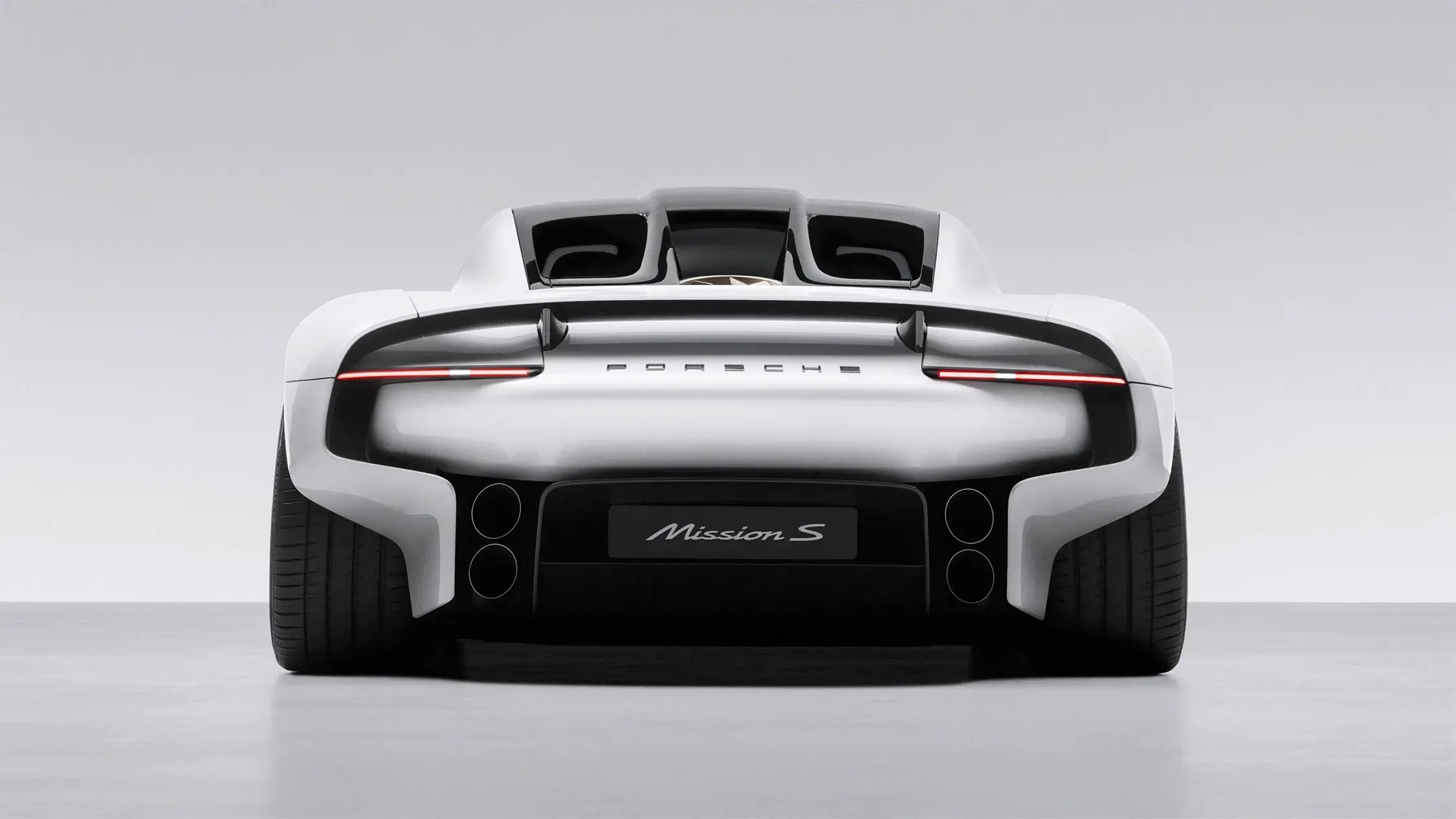
Porsche Mission S: the combustion-engine supercar that’s set to change everything for the brand
Porsche is going through a difficult period. Sales are falling, the electric Taycan has not proved as popular as hoped, and the 911 is approaching its commercial limits in the ultra-premium segment. The Stuttgart-based manufacturer’s response was not long in coming: the Mission S. A concept car unveiled at the 2026 Paris Motor Show that makes no secret of its ambitions: to take on Ferrari and Lamborghini on their own turf, with a petrol-powered sports car calibrated to really give them a run for their money.
Mission S
What Mission S really is – and what it isn’t yet
First and foremost, let’s be clear: the Mission S is a concept car. Porsche is publicising its design and intentions, but has not disclosed any official technical specifications. No power output has been announced, no weight, and no confirmed production date.
Nor is it a limited edition of just a few dozen units, like the 918 Spyder was in its day. The Mission S heralds a ‘mass-produced’ supercar – a relative term in this segment – priced at around 500,000 euros, produced in sufficient numbers to make a significant contribution to Porsche’s bottom line. This is where the real strategic innovation lies.
Porsche is not moving up the ladder within its own range. It is moving into a segment it has never occupied before: that of mass-produced luxury supercars. A territory that Ferrari and Lamborghini have regarded as their own for decades.
Design
Design: when Porsche looks in the rear-view mirror to go further
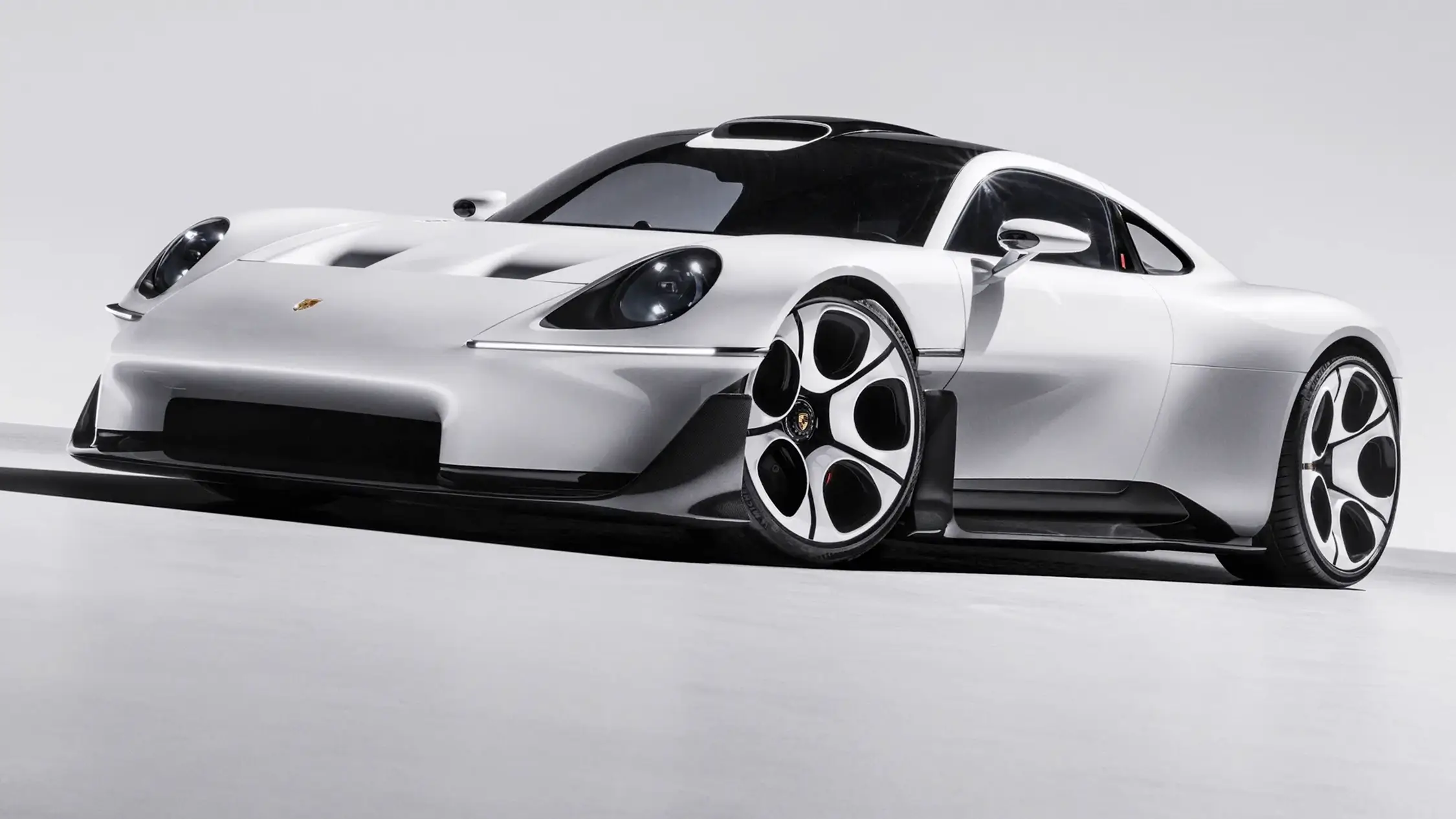
The first thing that strikes you about the Mission S is what it isn’t: a 911. No rear engine, no instantly recognisable silhouette. The Mission S features a mid-engine layout – a radical break with Porsche tradition, yet a natural choice for this segment.
This technical choice transforms the car’s proportions. The bonnet is short, the wings are wide, and the ‘Porsche Flyline’ – that roofline which dips towards the rear – is more pronounced than ever. The result is an instantly sporty silhouette that is recognisable even before you’ve spotted the badge.
Porsche has based this design on very specific references from its history.
The rear fan: a tribute to the 917
Functional in dissipating heat from the engine, yet evocative for any enthusiast who recognises the reference: the visible rear fan is a direct tribute to the 917, the most legendary racing car in Porsche’s history.
The dial-style wheels: a nod to the 928
A reinterpretation of the distinctive wheels from the 928, the great GT of the 1980s that Porsche had designed to succeed the 911 — before the 911 proved impossible to replace. These wheels make a comeback on the Mission S as a nod to boldness.
The muscular wings: the lines of the 911 GT1
The 1990s racing machine that competed at Le Mans with a mid-engine layout and lines of restrained aggression. It is this car that is most recognisable in the Mission S’s profile.
The perimeter line: a unique signature
A signature that links the front and rear lights by encircling the vehicle, creating a coherent, seamless sculpture. Nothing is superfluous; everything contributes to its identity.
Engine
What we know about the engine in this new Porsche Mission S
Porsche has not officially released any details regarding the Mission S’s powertrain. What can be gleaned from the concept car itself is limited but informative.
What has been confirmed
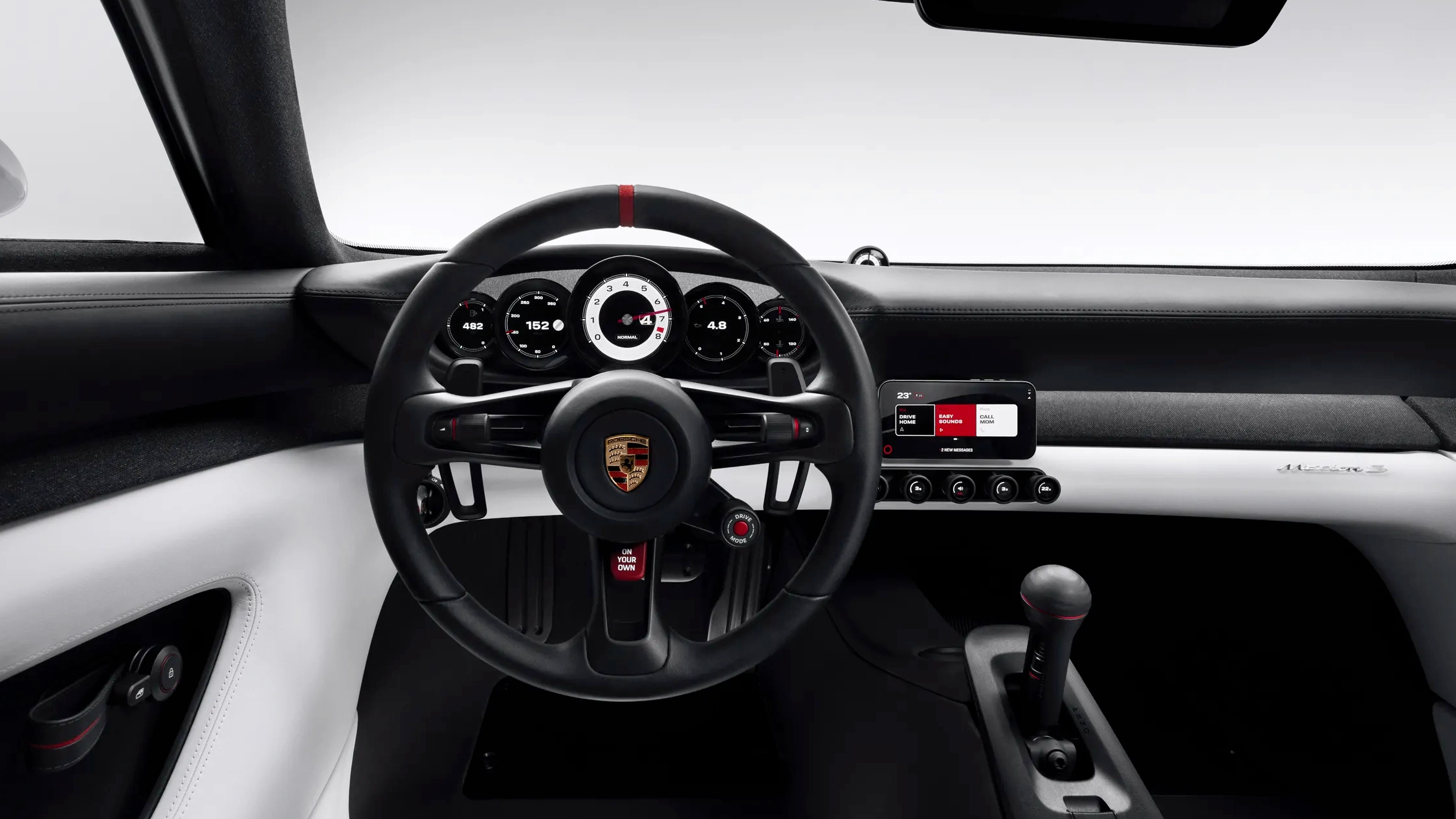
The rev counter displayed in the cockpit is graduated up to 8,000 rpm, with a redline starting a few hundred revs earlier. This is the hallmark of a high-revving sports engine; a diesel or a mild hybrid would have no reason to display this. The range displayed before the next refuelling is 482 km, consistent with a plug-in hybrid or a well-sized conventional internal combustion engine. Porsche also confirms an entirely new platform; there is no question of using an existing chassis, not even that of the Lamborghini Temerario.
What is being speculated
Hybridisation seems likely given the displayed range, but the exact architecture remains unknown.
The flat-eight: the engine Porsche has never dared to build
Rumours point to a completely new engine: a flat-eight, or an 8-cylinder boxer engine, which has never been produced by Porsche. An architecture that would logically continue the tradition of the 911’s flat-six and the Boxster/Cayman’s flat-four, but in a completely new range of displacement and power output. It would be the most ambitious engine Porsche has ever developed for a production car. Nothing has been confirmed.
Interior
A minimalist interior
The Mission S embodies a design philosophy rarely seen in a modern luxury car: nothing superfluous.
Your phone as the central display
There’s no touchscreen built into the dashboard. Instead, the driver’s phone takes up that space – a radical decision that returns connectivity to its rightful owner and keeps the dashboard uncluttered. When you get out of the car, you take your screen with you.
Five analogue dials
Five round dials, with an analogue needle-style rev counter in the centre. The other instruments rearrange themselves around it depending on the selected driving mode. The information is prioritised, clear and immediate.
The ‘On your own’ button
The Mission S’s standout feature: a red button on the steering wheel. Pressing it disables all driver-assistance systems. A deliberate action that requires a conscious decision. It embodies the opposite philosophy to cars that protect you against your will.
The finishes
The gear lever is height-adjustable, and the tactile feedback when changing gears is a priority. The key is made of aluminium. Even before starting the engine, every interaction with the car is designed to establish a physical connection with what you’re holding in your hand.
The face-to-face meeting
Porsche versus Ferrari and Lamborghini
Mission S is not merely a stylistic exercise. It is the response to a commercial reality that Porsche can no longer ignore.
Ferrari and Lamborghini generate operating margins of between 30 and 40 per cent on their most exclusive models. In this segment, every car sold is a cash cow. Porsche, despite its reputation, has so far played only a supporting role, with the most radical versions of its 911 – capable of breaking track records – but priced well below what a Ferrari 849 Testarossa or a Lamborghini Revuelto might command.
The Mission S changes the equation. At around 500,000 euros per car, it enters directly into the category where profit margins are the highest in the automotive market. And unlike ultra-limited runs, a substantial production volume multiplies the impact on the profit and loss account.
At a time when Porsche is under pressure from the Volkswagen Group to improve its profitability, the Mission S is as much a financial decision as it is a sporting one.
Shiftech
And for Shiftech, what difference does this make?
At Shiftech, Porsches are no strangers. The 992 GT3 RS takes pride of place as a show car in our workshops. Remapping is available for current Porsche models: 911, Cayenne, Macan and Panamera. And with the latest protocol updates, our coverage of recent Porsche models is constantly expanding.
But with the Mission S, it’s one mechanical possibility in particular that has caught our attention: the flat-8. It’s the sort of rumour that immediately makes us prick up our ears. A flat-eight in a production Porsche? If the manufacturer really dares to take the plunge, it would be an exceptional engineering proposition. A brand-new engine, a potentially unique sound and a strong identity to rival the V8s from Ferrari and Lamborghini: that’s the sort of gamble that can make for a memorable supercar.
On the other hand, there’s one choice that leaves us rather perplexed: a smartphone in place of the central display. In a car priced at around €500,000, it’s hard not to find this choice rather odd. The minimalist approach may appeal to purists, but at this price point, one also expects an in-car experience that matches the car’s exclusivity.
In the meantime, there’s no need to wait for a new supercar to arrive to explore the potential of your current Porsche.
Learn more
View articles
Similar


