Tesla Roadster 2026: the car that takes off – but can it be driven in France?
Nine years. That’s how long it took from the 2017 prototype to the demonstration on 15 October 2026 in McGregor, Texas. Nine years of delays, broken promises and customers still waiting for their deliveries. And then the spectacle: a car lifting off the ground, thrusters borrowed from Falcon 9 rockets, a noise that forces spectators to stay several hundred metres away.
We’ll tell you what it’s really worth – technically, commercially and legally.
2017 vs 2026
What everyone has forgotten: it’s not the same car any more
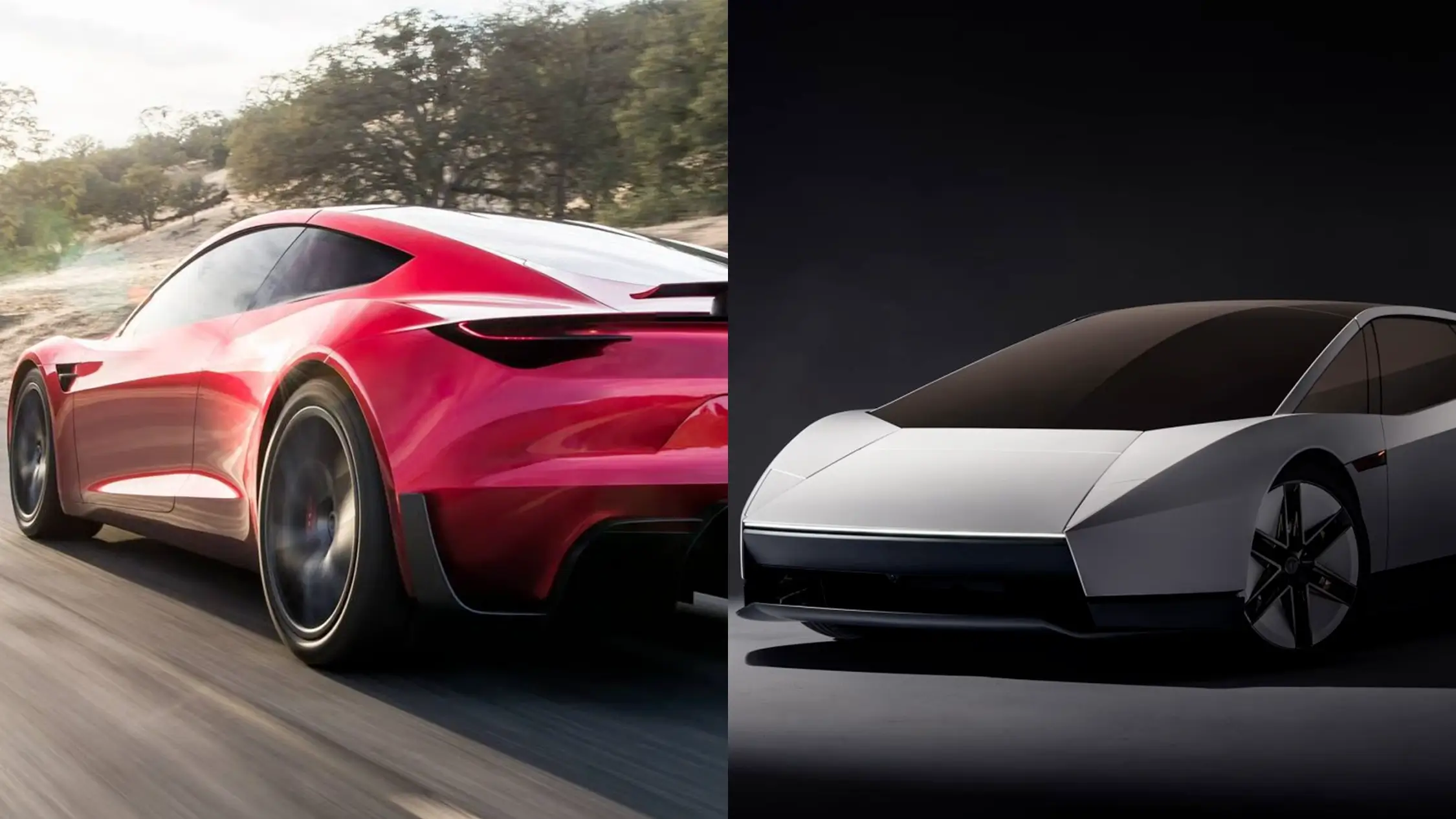
The Roadster unveiled on 15 October 2026 bears no resemblance to the one from November 2017. The original prototype was a sports GT with aggressive yet recognisable lines, featuring a removable roof and coupé-like proportions. The 2026 version is unrecognisable, with a far more radical profile and a completely redesigned silhouette, looking more like a track prototype than a production car.
Musk himself had warned over the years that the final version would be “very different” from the prototype. He wasn’t wrong. Except that the hundreds of customers who placed orders in 2017 did so on the basis of a design that no longer exists. And some of them were expecting deliveries as early as… 2020.
What happened on 15 October in McGregor
The SpaceX test site in McGregor, Texas – not a motor show, not a convention centre – provided the backdrop for a demonstration that felt as much like a space launch as it did an automotive unveiling. Guests arrived in Cybertrucks. The livestream began at 8.55 pm (Eastern Time). In the audience were Elon Musk, Franz von Holzhausen (Tesla’s head of design) and Lars Moravy (vice-president of vehicle engineering).
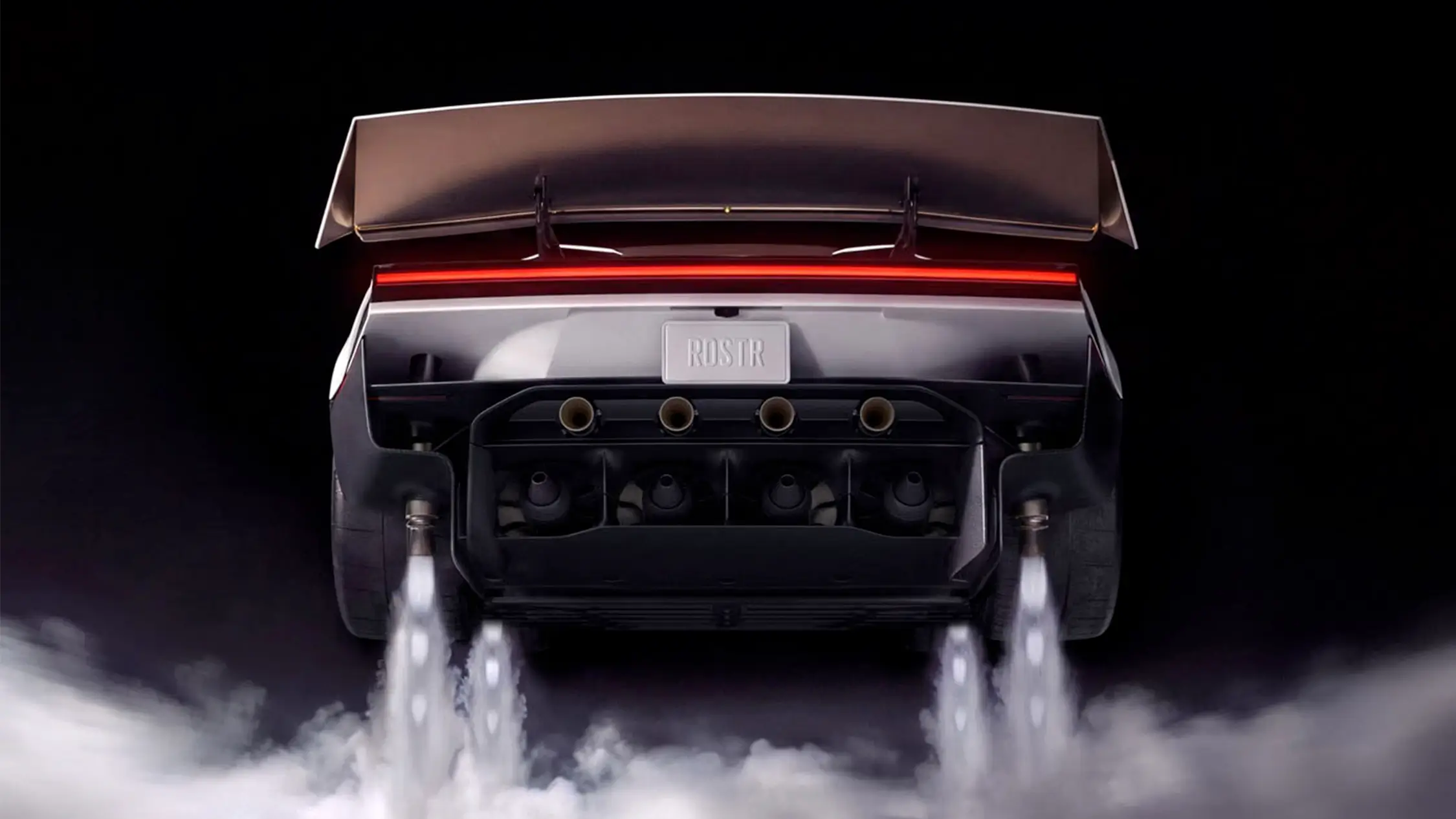
And then came the demonstration. A white Roadster raced up a massive curved ramp at full speed. Thanks to the Venturi ground-effect system – fans beneath the chassis that create a low-pressure zone – the car remained glued to the ramp even as it passed upside down, at 180 degrees. It remained suspended, upside down. It then lifts off the ramp, activates its cold-gas thrusters, leaps over a row of cars and a Tesla Semi, performs a complete flip in mid-air, and lands on its wheels on the other side.
Lars Moravy then demonstrated a 0–100 km/h sprint in under a second, timed in front of the audience.
Elon Musk concluded: “It turns out that the future does indeed have flying cars.” Moravy added: “Flying cars are real.”
Two versions were unveiled: a standard road-legal version and a limited-edition SpaceX Edition, the latter explicitly not road-legal in any country.
How do the SpaceX thrusters on the Tesla Roadster work?
This is where it gets interesting. The Roadster’s thrusters are nothing like a rocket engine. No combustion, no fuel being burnt. Here are the physical principles at work.
Ground suction: the standard version
On the basic version, Tesla uses fans under the chassis combined with movable side skirts. By drawing air in from beneath the car, an area of extreme low pressure is created via the Venturi effect. The pressure difference between the underside and the top of the vehicle generates massive downforce — even when stationary or travelling at very low speeds. This is what enables the 0–100 in 1.9 seconds without the tyres lifting off the ground.
Cold-gas thrusters: the SpaceX version
The SpaceX Package is based on Newton’s third law: action and reaction. Air or nitrogen is stored under very high pressure in COPV tanks (600 litres at approximately 700 bar). It is then expelled at very high speed through around ten cold-gas nozzles, generating an instantaneous gross thrust of over 80 kN at the rear.
As there is no combustion, the compressed gas absorbs ambient thermal energy as it expands: hence the term ‘cold gas’. This is exactly the same technology that SpaceX uses for attitude control and the landings of the Falcon 9 boosters.
By directing certain nozzles downwards, the car can briefly lift off the ground. By directing them backwards, it can reach 0–100 in under 1 second — a figure that exceeds the physical limits of tyre grip on tarmac under normal conditions.
| Component | Component | Function |
|---|---|---|
| COPV tanks | Gas at 700 bar | Potential energy reserve |
| 10 cold gas nozzles | Newton’s third law | Instantaneous gross thrust (>80 kN) |
| Optimus actuators | Ultra-fast valves | Precise control, flight stability |
Tesla Roadster 2026 prices: how much does each version cost?
| Version | List price |
|---|---|
| Base | $200,000 |
| Founders Series | $250,000 |
| SpaceX Edition | Unconfirmed — “several hundred thousand dollars” |
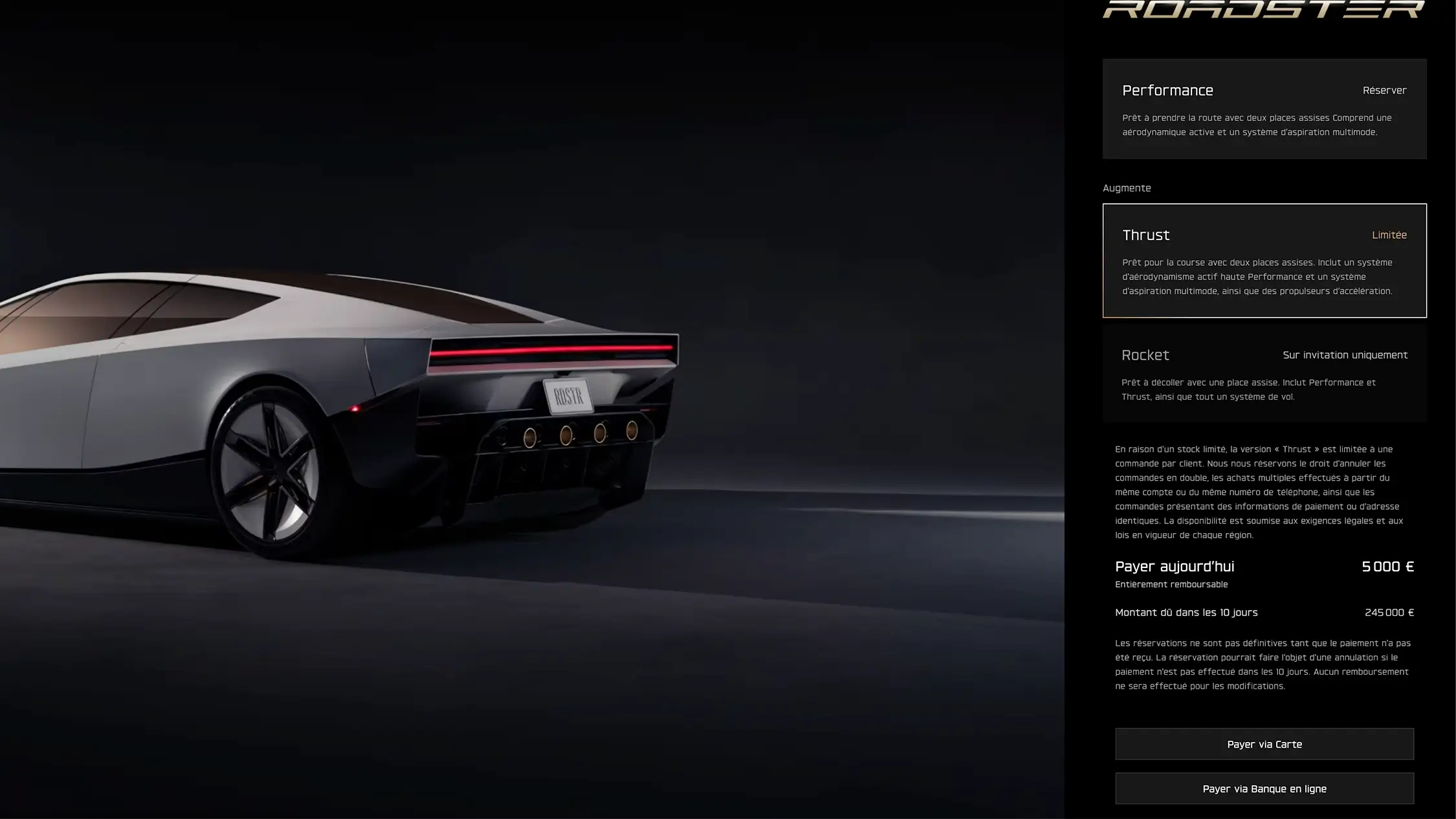
A deposit of $50,000 is required to reserve a vehicle. All official information and the booking page are available at www.tesla.com/roadster. Production is scheduled for 2027–2028 at the Gigafactory in Texas. For the record, reservations made in 2017 required a $50,000 deposit and promised deliveries in 2020. Those customers are still waiting.
The 2026 Tesla Roadster in France: legal, type-approved, available to buy?
The standard version
Tesla states that type-approval is subject to the laws in force in each region. In Europe, the type-approval procedure (UNECE/EC regulations) will need to be completed. Nothing has yet been finalised. No timetable has been announced for European type-approval.
The SpaceX version
The answer is straightforward: no. Tesla states this explicitly on its official website: “Availability is subject to legal requirements and the laws in force in each region.” The Rocket package “may not be available in all regions.”
In France, 700-bar tanks integrated into a road vehicle, cold gas nozzles capable of lifting the car off the ground, and a noise level requiring an exclusion zone of several hundred metres: there is no regulatory framework for type-approval of this system. Neither the Highway Code, nor UNECE standards, nor the MOT test have a category for an “on-board space propulsion system”.
Even in the United States, the SpaceX version will probably never be registered for use on public roads.
The ‘Roadster effect’ on Tesla shares: why the share price has soared too
The announcement had an immediate effect on TSLA’s share price. It’s the classic Musk formula: a spectacular event, a demonstration generating billions of impressions on X, and a market capitalisation that incorporates the halo effect far beyond the product itself.
The Roadster is not a mass-market product; at a minimum price of $200,000, it never will be. But like the Cybertruck, and like the Falcon 9 that lands upright, it is a storytelling tool. It says: Tesla is a company that does the impossible. And the markets are buying into this story just as much as they are buying the cars.
Reality, technology or marketing: what’s really behind SpaceX’s rockets
That’s the real question. And the honest answer is: all three at once.
What is real and technically valid
Cold-gas thrusters exist, work and are a tried-and-tested technology in space. The demonstration on 15 October is not CGI. Newton’s third law does indeed apply. A 0–100 in 0.59 seconds with this system is physically plausible; the ground-based suction system solves the traction problem that mechanics alone could not overcome.
What is a gimmick on the road
The SpaceX version cannot be driven on public roads. The 700-bar COPV tanks have a limited range, providing just a few seconds of maximum thrust before needing to be recharged. The cost of maintaining and refilling the nitrogen or compressed air makes every use a logistical nightmare. And the standard version’s 0–100 in 1.9 seconds is already beyond what is legally permissible on public roads.
This is pure marketing
The convergence of Tesla and SpaceX into a single product, the event at a rocket launch site, the term ‘Rocket’ in the package’s name – all of this serves to position Tesla as a leading technology company, not just as a car manufacturer.
In what situation would this system be of any real use?
On a closed circuit, for elite motorsport or controlled speed records. This is the only context in which the technology can demonstrate its value without coming up against regulations. As for the rest, the standard version of the Roadster – 0–100 in 1.9 seconds, 400 km/h, 1,000 km range – is already the highest-performing car ever mass-produced. The SpaceX propulsion systems are a demonstration of technological prowess, not a practical solution.

Whilst we wait for Tesla to deliver on its promises
Learn more
View articles
Similar


