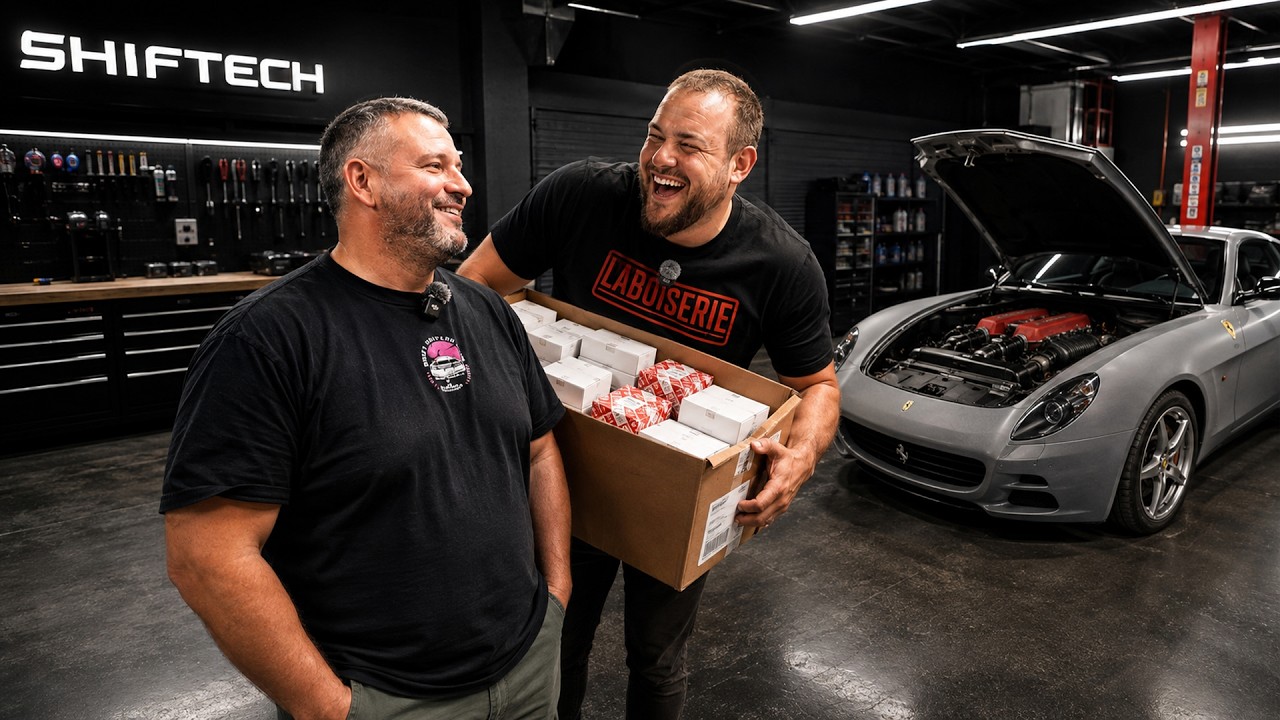
Ferrari 612 Scaglietti: what does it really take to restore a V12 to working order?
When Lucien Boiserie parked his Ferrari 612 Scaglietti on the forecourt and pushed it into the Shiftech Tours workshop, the situation was clear: no brakes, cracked timing belts, a gearbox leak, and fluids dating back to 2016. The car was bought for 20,000 euros. Once restored, it will be worth between 75,000 and 100,000. In between, there’s €17,000’s worth of genuine Ferrari parts and a V12 overhaul that Médéric has agreed to take on.
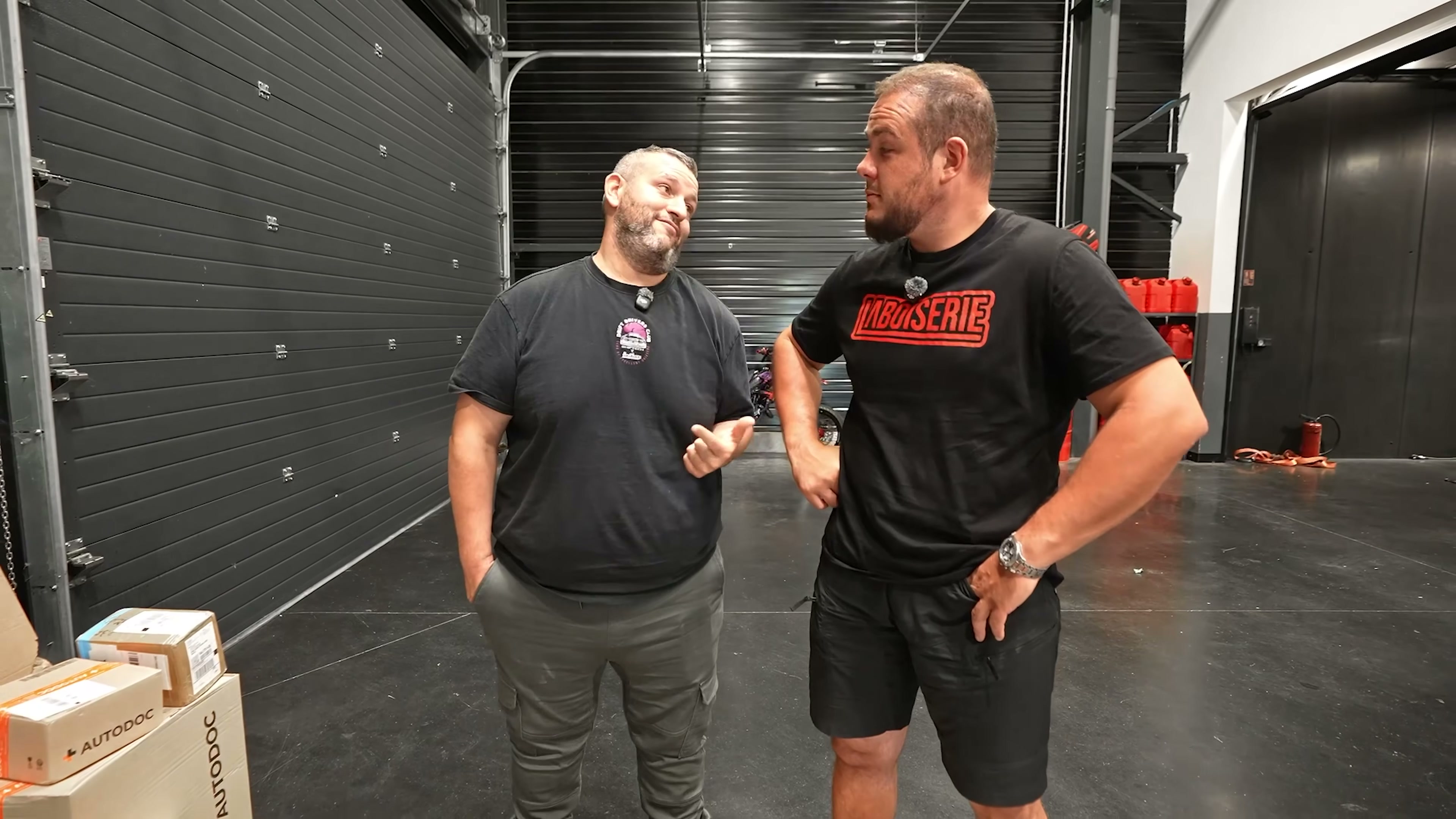
The Ferrari 612 Scaglietti in a nutshell
Produced from 2004 to 2011, the 612 Scaglietti is a 2+2 aluminium coupé powered by a naturally aspirated 5.7-litre V12 engine producing 540 chevaux and 588 Nm at 5,250 rpm. It features a 6-speed automated manual gearbox (the famous F1-A of the time), rear-wheel drive, and accelerates from 0 to 100 km/h in 4.2 seconds. The car weighs 1,840 kg and features a dry-sump system, which is no small matter: we’ll come back to that.
It isn’t the most sought-after Ferrari on the market. That is precisely why it sold for 20,000 euros in the condition it was in, whilst a well-prepared example easily fetches over 75,000. It was a real bargain. It also came with a full restoration project on its hands.
What we found on arrival
The car arrived on a flatbed. Not on its own wheels, not idling: on a flatbed, because the brake calipers were no longer fitted. They’d been removed and repainted – which is a good idea – except that the pistons hadn’t been refitted. No brakes, so no attempt was made to start the engine until the oil had been checked.
The initial diagnosis revealed several points of concern:
The timing belts were visibly cracked on visual inspection, and the mileage since the last service was not sufficient to account for their condition. The last recorded oil change was in 2016. The fluids had not been changed since then. The gearbox had a leak in the hydraulic assembly, near the gear selector. The windscreen had cracked due to areas of rust around the edge of the bodywork. Several tie-rod ends and wishbones were showing play. And the tyres, although they looked new, still bore their original labels dating from a bygone era.
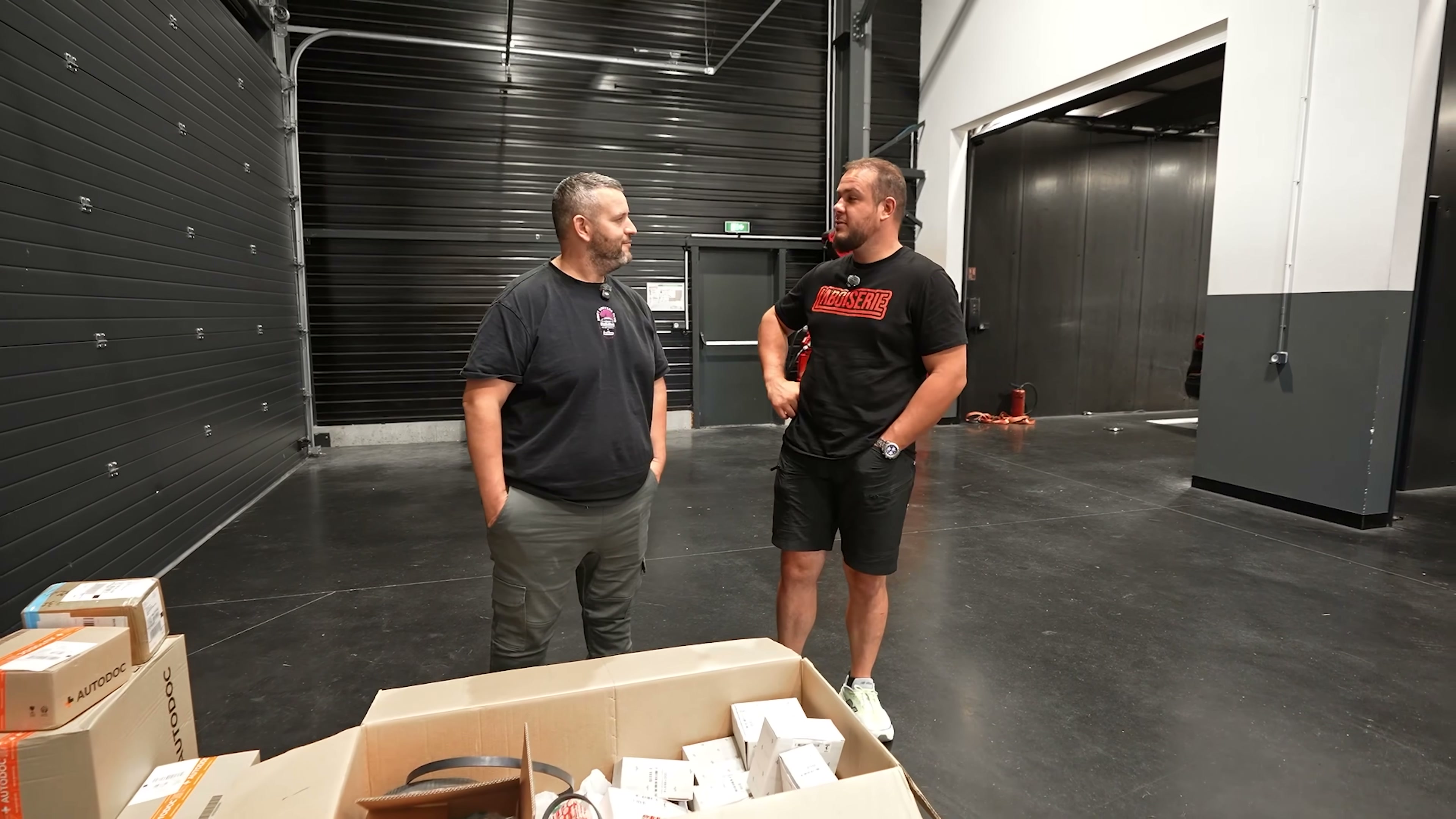
€17,000 worth of original parts: why no aftermarket supplier will do
This is one of the aspects that many people underestimate about these generations of Ferrari: there are virtually no aftermarket suppliers capable of providing mechanical parts in the correct specification. Ignition coils do not all share the same part number depending on their position on the V12. Brake discs cannot be found outside the Ferrari network. The water pump, tensioner pulleys, timing belts: everything has to go through Maranello or an authorised dealer.
In practical terms, the order includes: 12 ignition coils (whose part numbers vary depending on their position), NGK Racing spark plugs, two oil filters (the 612 has two fitted as standard), an air filter, a cabin air filter, the timing belt tensioners and timing belts, the auxiliary belt with its pulley, the water pump with its housing, the boot and bonnet struts, the front and rear brake pads, and the replacement fluids specified at reception: Motul 8100 X-cess Gen 2 in 5W-40 (13 litres, due to the dry sump system), Motul Gear 300 75W-90 for the gearbox, and Motul Multi ATF for the hydraulic system.
An important point to note before starting the job: the water pump seals were missing. This is the sort of detail that gets overlooked when ordering and which can result in a week’s delay if not anticipated. Everything was opened up, checked against stock, and the missing parts ordered before starting.
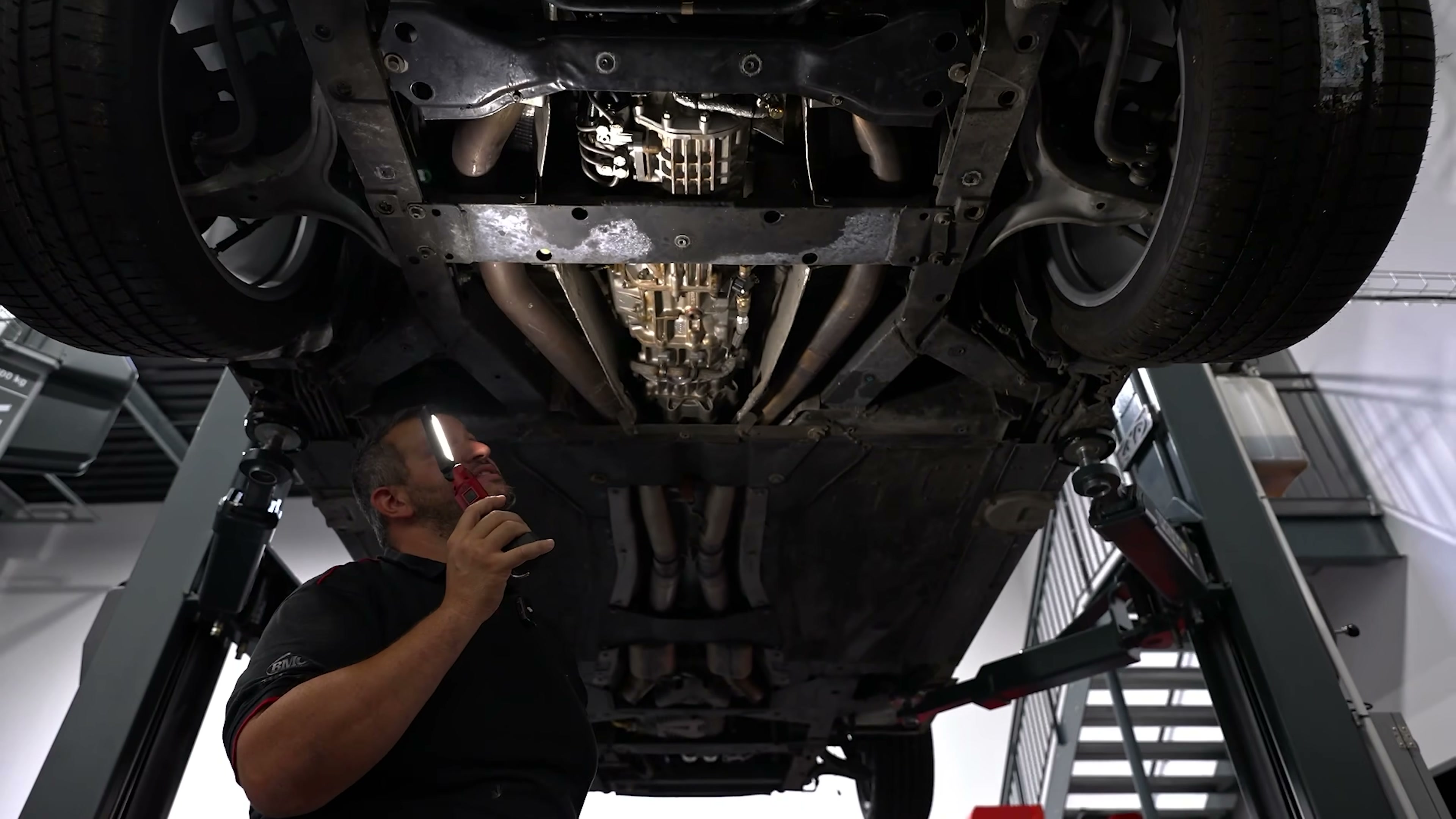
The powertrain of a Ferrari V12: a project in its own right
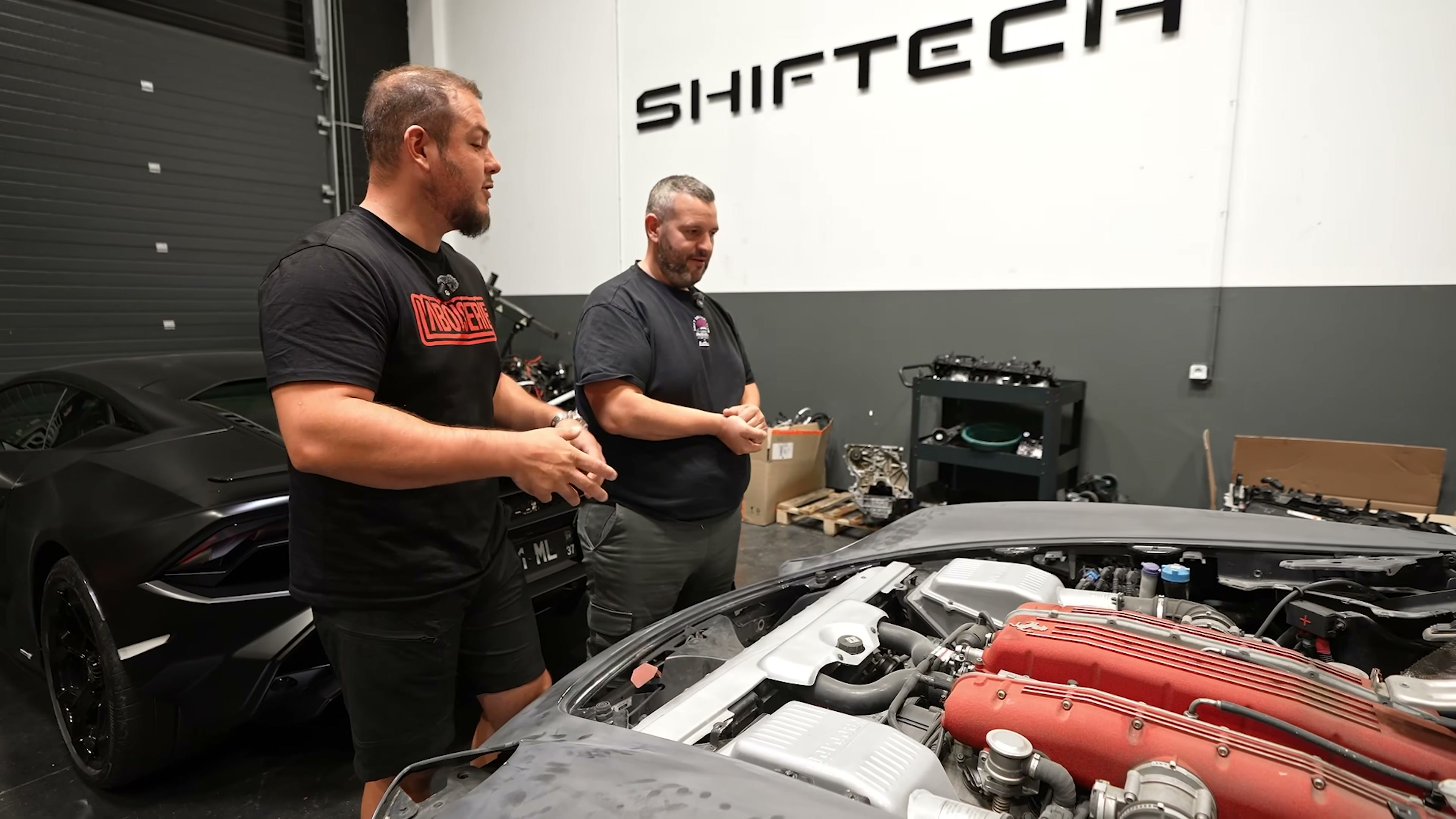
Changing the timing on a naturally aspirated V12 engine is no more complicated in itself than on other engines, with one exception: gaining access to it. On the 612, the V12 is positioned very far forward and very low in the chassis to lower the centre of gravity. The crankshaft pulley is accessible, but the rack runs right in front of it. Several mounting points at the front require the removal of ancillary components to reach the bolts, and depending on the work involved, it may be necessary to remove certain chassis parts.
The Shiftech Tours team has plenty of experience with complex engines, but a Ferrari V12 is still an engine you don’t come across every day. The rule is simple: check the compression whilst the spark plugs are out, verify the timing pins, and consult the technical documentation before touching anything. On this type of engine, a mistake when reassembling the timing system can ruin the entire engine.
The belts were visibly cracked. The repair could not be delayed any further.
Automatic gearbox fluid change: Shiftech’s expertise in the world of supercars
The 612 Scaglietti’s gearbox is a hydraulically controlled automated manual transmission, with gear selection via a hydraulic actuator. It is not a torque converter automatic gearbox in the traditional sense, nor is it a dual-clutch system. It is a design specific to Ferraris of that era, which is a little slow in operation but offers a crisp response.
The leak observed on the hydraulic shift mechanism is common on these ageing gearboxes. We order the relevant seal and carry out a complete fluid change using the recommended fluid. The gearbox fluid change procedure for this type of supercar follows the same principles as for conventional automatic gearboxes, which Shiftech services regularly: changing the fluid whilst the gearbox is warm, replacing the seals, and refilling to the exact volume and with the correct fluid. The distinctive feature here is access, as the gearbox is positioned as a rear cantilever unit – as on a Nissan GT-R – in the boot, connected to the engine by an all-wheel-drive tunnel.
Dry sump, offset oil pan: what this actually means in practice
The 612 Scaglietti uses a dry sump system, which warrants a brief explanation. In a conventional wet sump engine, the oil is stored in the sump, beneath the crankshaft, and the pump draws it directly from there. The drawback of this system at high revs or when cornering hard is that the oil shifts around, and the pump can draw in air – a phenomenon known as cavitation.
On the 612, Ferrari opted for a dry sump system. The oil is not contained within the engine block: it is stored in a separate reservoir, visible in the rear left-hand compartment. A high-pressure pump feeds oil to the engine, whilst a return pump continuously draws oil back down into the lower engine block and returns it to the sump. The circuit also passes through an oil cooler, which is also positioned outside the engine block.
There are two advantages to this: the engine can be mounted lower in the chassis (there is no need to leave space beneath the crankshaft for the sump), and lubrication remains effective regardless of lateral load transfer. The total oil capacity of the 612 is 13 litres, compared with 8 to 9 litres in a conventional V8 engine. This should be taken into account when budgeting for fluids.
The next stage of the project
Once the mechanical work is complete, the car is due to be fully repainted at our partner body shop. The car had been repainted black over its original yellow paintwork, and the work had been poorly executed. The next step after the car has been fully reassembled is a visit to Proweld for the exhaust system, followed by a wrap-up video with Lucien driving along the Mediterranean coast.
The aim was never to carry out a show-quality restoration. It’s a Ferrari bought for 20,000 euros, restored to impeccable condition for around 17,000 euros in parts plus labour and paintwork, and resold for between 60,000 and 80,000 euros. Which, incidentally, makes it a fairly realistic budget exercise in terms of what it actually costs to own a 540-cheval V12, of which 3,100 were produced.
€16,000 WORTH OF PARTS IN LUCIEN’S FERRARI (The cheapest one)
Learn more
View articles
Similar


